New: Start(eR) profile in grey polycarbonate
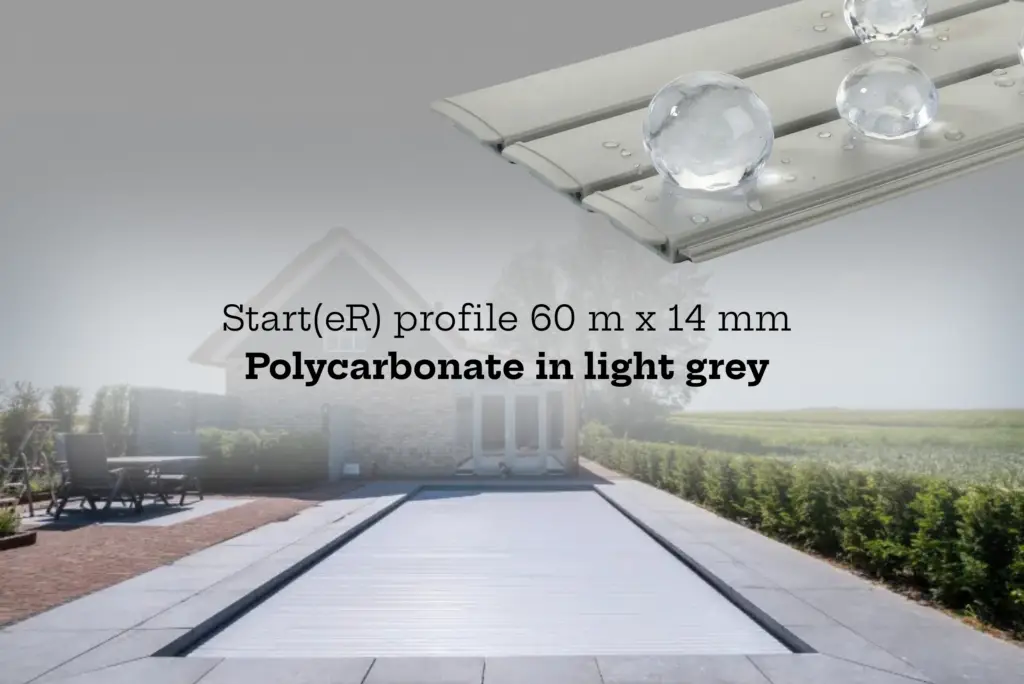
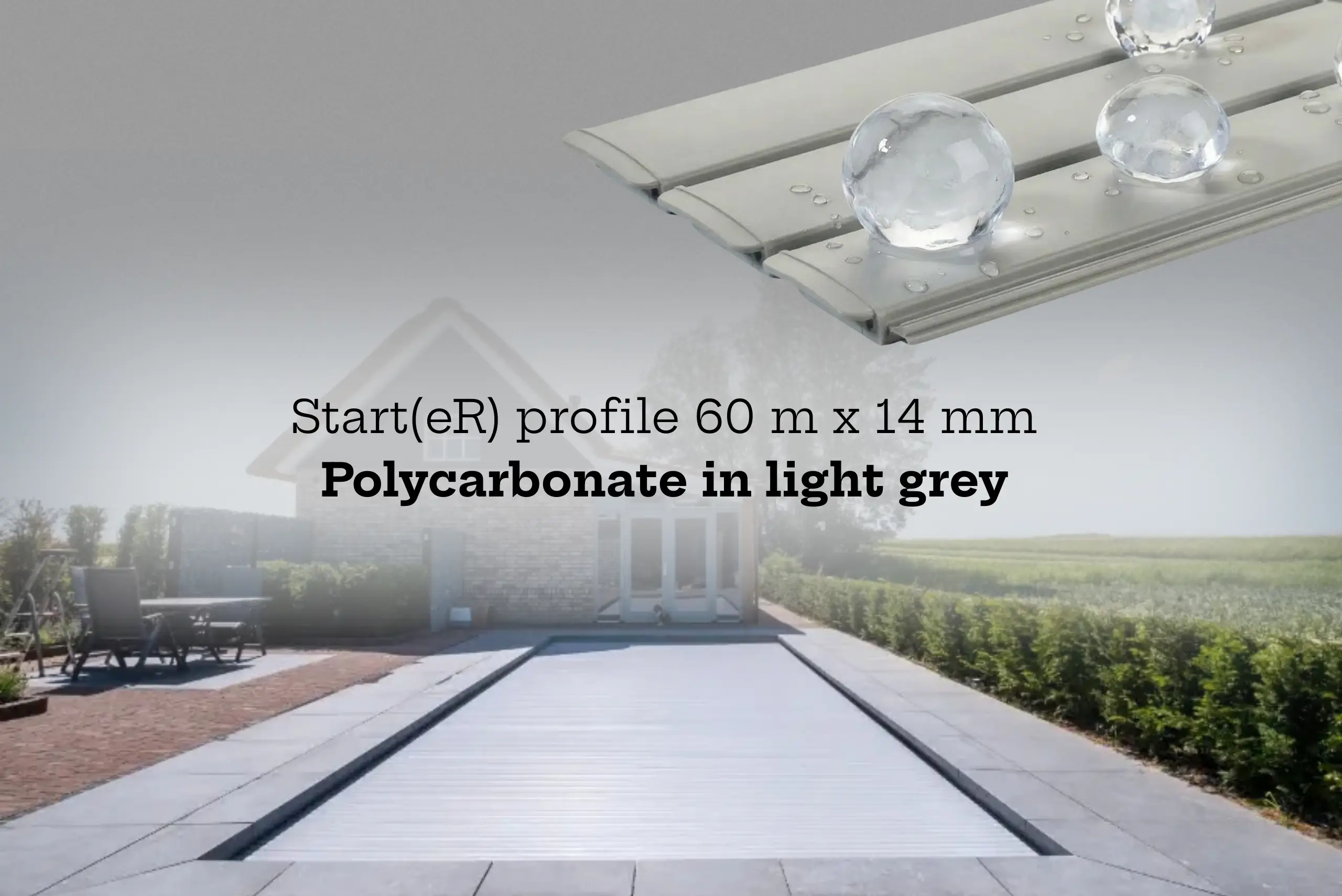
A solid light grey polycarbonate slat for projects where dimensional stability, impact resistance and a neutral appearance are essential.
Pool covers spend most of their service life outdoors. Sun exposure, UV radiation and temperature fluctuations continuously affect the material. As summers become warmer and heat peaks occur more frequently, the material choice of pool cover slats is becoming increasingly important.
Particularly with dark or grey pool covers, the temperature of the slats can rise surprisingly high in direct sunlight. The surface temperature of a closed slatted cover can become significantly higher than the ambient air temperature.
For pool professionals, it is therefore important to look beyond colour or price alone and also consider the thermal behaviour of the material from which the slats are made.
The Vicat softening temperature of PVC
PVC has been widely used in pool covers for decades. It is relatively economical and can be easily extruded into slat profiles. At the same time, PVC has an important material characteristic that should be taken into account: the Vicat softening temperature.
The Vicat temperature indicates the point at which a plastic begins to soften under mechanical load. For PVC this temperature is typically around 70-80 ° C.
While this may appear high, slats exposed to direct sunlight can in practice reach temperatures close to this range surprisingly quickly. This is especially the case with:
- dark or grey slats
- pools with limited or poor water circulation beneath the cover
- overflow pools or steps located close to the water surface
- pools situated under glass structures or in conservatories
When the material temperature repeatedly approaches the Vicat point, PVC can gradually lose stiffness. Over time, this may lead to deformation of the slats.
Changes in PVC formulations
A lesser-known aspect is that the composition of PVC has changed over the past decades. Historically, certain stabilisers and additives were used to improve the thermal stability and ageing resistance of PVC. Several of these substances are now restricted or no longer permitted in Europe due to environmental and health regulations.
Modern PVC formulations fully comply with current regulations, but the properties of the material therefore differ from those of earlier generations of PVC. For pool professionals, it can therefore be worthwhile to pay attention to the origin of the material and the extrusion process when sourcing PVC slats. The quality of the raw materials and the production process have a clear influence on the long-term performance of the slats.
Polycarbonate as a stable alternative
When maximum dimensional stability and long service life are required, the pool industry increasingly relies on polycarbonate slats. Polycarbonate has a significantly higher Vicat temperature than PVC, typically around 140–150°C. This means the material remains structurally stable even when exposed to high surface temperatures.
Until now, polycarbonate has mainly been used in transparent or solar slats, as the material is highly transparent and UV stable. However, not every pool project requires a solar effect. In many installations, a solid, neutral colour is preferred.
For this reason, (Re)Cover developed a light grey polycarbonate slatcombining the appearance of a traditional grey cover with the structural advantages of polycarbonate. (Re)Cover is currently the first and only manufacturer in the market offering a light grey polycarbonate slat.
Highest hail resistance (HW5)
During the development process another advantage became evident. Polycarbonate is known for its exceptional impact resistance. For this reason, the slats were tested according to the Swiss VKF hail register, an independent testing system that simulates the impact of hail on building materials. The slat achieved HW5 for functionality, the highest classification possible within this test.
Although hail resistance was not the original objective of the development, it represents a valuable additional benefit for installations in regions where extreme weather conditions occur.
A conscious material choice for pool covers
For pool professionals it is becoming increasingly important to look beyond the visual appearance of a slatted cover. Climate conditions are changing, material formulations continue to evolve and expectations regarding durability are increasing.
For projects where a neutral appearance is desired, but where maximum dimensional stability, impact resistance and long service life are also essential, grey polycarbonate provides a robust alternative to traditional PVC slats. Not as a cosmetic variation, but as a structural material choice for modern pool covers.